
Enter Galactus!
A Marvel Snap insight into one of the first two perpetual Series 5 cards. Its time for my Galactus Guide!

The Biggest, The Baddest, The Coolest Animation
Galactus is one of the most iconic “Big Bads” of the Marvel Universe, and in Marvel Snap there is no exception. He is one of the two original cards that was slated by Second Dinner to stay within Series 5. Collecting him is not only saved until the late game, but unless you have astronomical luck pulling him from a cache you will have to spend a whopping 6000 collectors tokens in order to purchase the card.
This past weekend I caved, and ended up purchasing Galactus rather than waiting for the new Kang card which was slated to release today. This temporarily completed my collection of the perpetual Series 5 cards, but this was undone when Kang officially dropped earlier this afternoon. This decision has seemed to be the correct one so far, as Galactus has been a ton of fun to play with, and at the rate that I am currently earning collectors tokens I should expect to be able to pick up Kang in a week or two.
After a brief period of play, I have had some surprisingly insightful conclusions about playing Galactus, and honestly I haven’t seen much discussion about this card or his archetype from others in the Marvel Snap space, so my thoughts may actually have some impact in this situation. The following will be a bit of a guide on typical play patterns surrounding Galactus, observations that may not be immediately intuitive, and a look into some of the innovation that I have made with the deck that I have not seen from others.
Take all of what I say here with a grain of salt… Like I said, I have only been playing this deck for this week, and don’t have all the kinks worked out as of yet, but I think that I have had some insight into the deck that may be useful to those who are either new to the card, or maybe provide a fresh perspective to some of the seasoned veterans who have dismissed the card as having too rigid of a play pattern.
Macro Level Game Plan
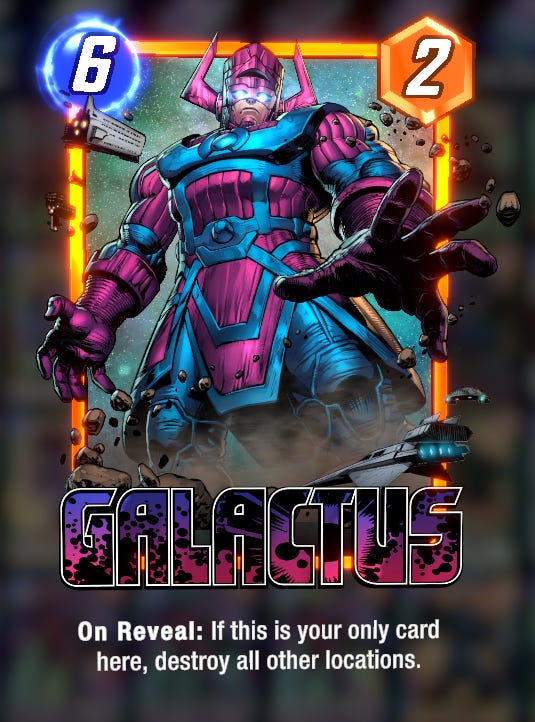
With Galactus’ ability being so game-impacting, it has been been fairly easy to characterize his deck’s game plan. At a macro level, the strategy seems to break into three different components. First, play a ramp card so you can play Galactus on turn 5 (or earlier). Two, play Galactus on your opponent’s weakest lane that you have no cards in. Three, play large stat-cheating minions in the lane to have more power than your opponent and win the game. Sounds easy right? That is what I thought prior to playing the deck, and boy was I wrong. There are a number of factors which make you deviate from this typical play pattern, and your approach to mitigating them is reflected through how you build your deck.
Micro Level Gameplay & Gameplay Deviations
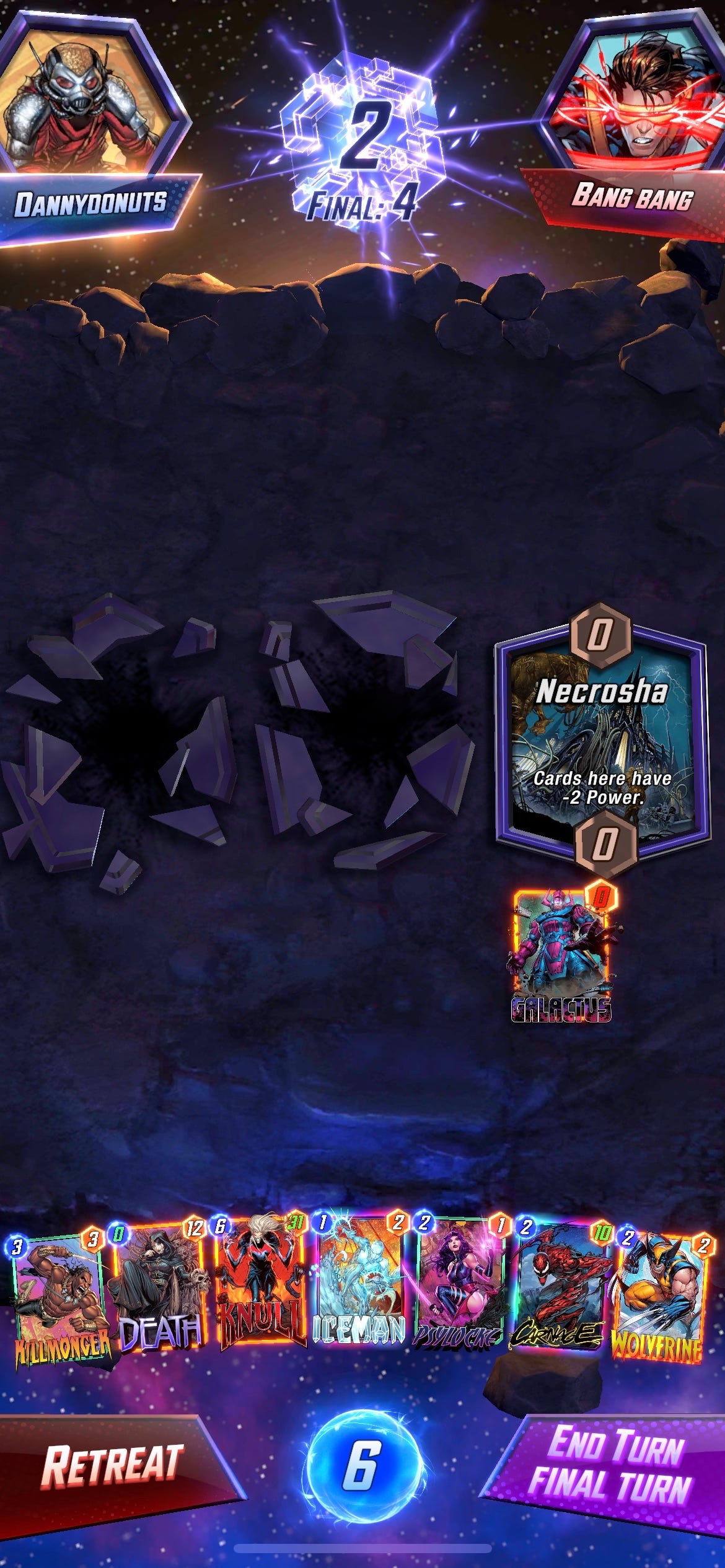
In a “standard” Galactus deck, there are a couple of things to keep in mind. First, this deck archetype is EXTREMELY telegraphed if certain cards are played, allowing your opponent to try to counter your game plan. For example, if you play Wolverine followed by any ramp card and if your opponent is experienced they will either try to counter your strategy or retreat if they don’t have a counter. In order to improve your gameplay, you have to understand how your game plan can potentially fail. How is Galactus countered? There are a few different ways:
Opponent stops Galactus’ on reveal effect
This is the primary way to get blown out while playing a Galactus deck, especially when looking at some of the snap related tendencies when piloting the deck (More on snapping & cube equity later). There are a handful of ways that your opponent can influence this, but the majority of them are due to the fact that they will most likely have priority going into turn 5 and as such your opponent will try to turn off Galactus’ ability outright, add a unit to the lane before he reveals, or move Galactus to an already occupied lane. Cosmo and Aero are the two primary card cards which counter Galactus in the current meta, but there are some others that are less commonly used such as Debrii, Doc Oc, Juggernaut, Polaris, and the Goblins. Additionally, you can be blown out by Leech, which if cheated out early hits your Galactus, but to add insult to injury will make your Death, Knull and Shang-Chi unusable.
As you play against decks that may be running these types of cards, a positioning strategy naturally develops to “counter the counter”, especially against meta lists that you happen to know are running Aero. By completely filling one lane with four cards on turns 1-4, you can prevent Aero from being able to redirect your Galactus into a lane that has other cards in it, additionally keeping two potential lanes to choose between for Galactus. However, keep in mind that stacking one lane also telegraphs that you are playing Galactus, so decks that may be running some of the other counters (such as Polaris) may take advantage of this “tell”.
Opponent wins the Galactus Lane
While setting up Galactus into an empty lane can be difficult, once you have destroyed the other two locations the game is not always over. While most of the time your opponent will retreat from a Galactus play, sometimes your opponent will opt to stay in the match. If you consider why an opponent would stay in the game past having the rest of their board destroyed, Shang-Chi is often the culprit. There are a couple of things to be concerned with if you find yourself in this situation. The main one centers around priority. Most of the time, you want to actually be behind in priority to avoid Shang-Chi. If you have priority by playing Galactus in to an empty lane and were to play Death & Knull on turn 6, you have the chance of losing to an errant Shang-Chi 3 power to 2. (assuming that you have not played Wolverine earlier in the match). In a similar but much less seen situation Knull can also be countered by an Enchantress. Sometimes, against certain decks like Sera Miracle, it is right to NOT play the cards with the strongest power > 9, but to put just enough stats on board to counter a Shang-Chi plus one, as the only reason your opponent is still in the game is because they think they can cheese out a win.
Additionally, sometimes you have to play Galactus into a lane that is already fairly developed by your opponent due to location shenanigans limiting the options on where you can place Galactus. Just remember that getting your Galactus effect off is not an “insta-win” and don’t be afraid to retreat if you think you ultimately will lose the lane.
Restrictive location RNG
The caveat of playing Galactus into an empty lane can really be exacerbated by some of the locations that pop up across the Marvel Snap’s landscape. You have to remember that you both need to play your early game and ramp cards across one or two lanes, then Galactus in another. Certain location combinations inhibit this, especially when you start adding cards to the board prior to all the locations being revealed. My least favorite location with the first revisions of the deck that I played was Central Park as it immediately shut off my Galactus, but I was also screwed over by Knowhere preventing his ability to go off, being beaten by Mojoworld as the only viable Galactus location and only being able to play 3 cards there, Morag, Plunder Castle & Sanctum Sanctorum limiting lane options and Savage Land, Shadow Land and Monster Island not being empty locations.
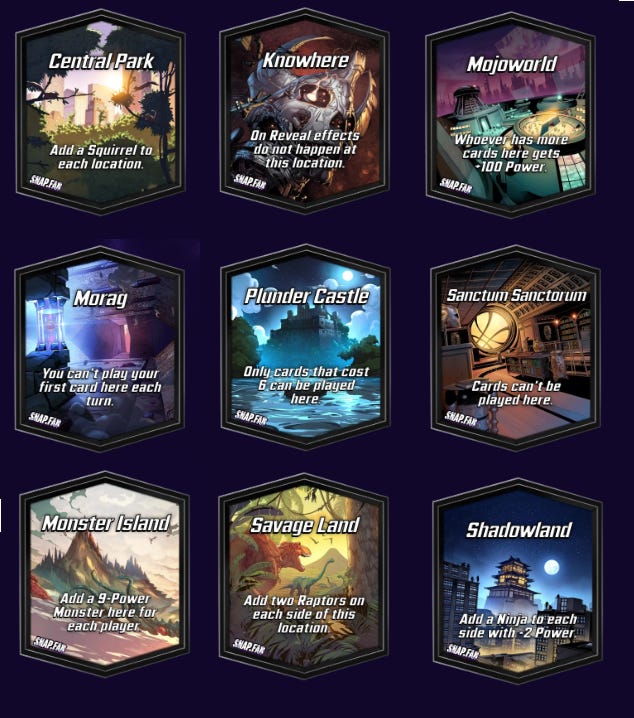
There are some other interactions with locations that effect the game, such as utilizing negative locations to make sure that you will have priority going into the final round, but my favorite are locations that destroy or remove your played cards like Rickety Bridge, Death’s Domain, Death’s Alter and Luke’s Bar presenting you with an opportunity to win via a Turn 6 Galactus after putting a Wolverine down on board earlier.
Cube Equity & Snapping Mentality

Similarly to how the old Zabu / Spiderman combo was known as a “two cube” deck Galactus initially appears in the same style of shutting the game out and having your opponent retreat after only collecting two cubes, and for the most part this is true. However, I was a little bit surprised by the number of people who stayed in after I had destroyed two lanes, even into some of the higher ranks of the game. I believe this ties back to Shang-Chi being a staple in the metagame & people thinking they can beat you using him as a “cheese” win, so expect to get a solid amount of 4 and even 8 cube games.
When it comes to snapping, I believe that getting in an optimal snap is actually extremely nuanced when it comes to this deck, and I honestly don’t think that I have it completely under my belt. However, here are some of the key takeaways that I have determined as of so far:
First, you want to snap as soon as possible with this deck, assuming that you know you are going to win the game. This may seem like common sense (like the old saying, “just score more points than your opponent”), but if you really strip it down, how do you know that you are going to win the game? Then once you have figured that out extrapolate it into how you can maximize your opponent staying in the game.
Lets look at the implication of the timing for when you snap. If you were to snap after Galactus has revealed on turn 6 and the two locations are already gone, most people will leave the game straight up. A slightly better snap timing is before you play Galactus on 5, however, against good opponents they will recognize that due to your Wave or Psylocke you are playing Galactus and will either retreat or even specifically try to counter your Galactus’ ability. This is why a turn 3, 4 or even as early as turn 2 snap is optimal to maximize your cube winnings, assuming you can pull off the Galactus play.
I typically look at four different factors before snapping. These are some of the things that I take into account:
Cards in hand - Do I have Galactus in hand? Have I drawn a Ramp Card? Do I have a “Pay off” Card in hand (Death, Knull)? I am typically comfortable snapping once I have Galactus and one of the other two card prerequisites barring any location issues.
Locations - Do any of the locations inhibit my game plan (blocked off, spawned units, prohibited on reveal effects?). Sometimes I will intentionally play my 1 and 2 drops into an unknown location if the first location is a “safe” Galactus location to get ahead of being “blocked out” from playing Galactus in the late game.
Opponent’s Deck - What is my opponent running? Do the meta versions of the archetype run cards that can influence my gameplay? For example, if my opponent plays Bucky & Carnage, I am more hesitant to snap if my non-Galactus lane isn’t full, as the current meta versions of the Death-Wave list run Aero.
Galactus Deck Transparency - How telegraphed have I been this game? Have I played cards that are only run in Galactus lists? Ultimately you are trying to convince your opponent that you are running a list OTHER than Galactus, then surprise them with the Galactus play to maximize cube equity. Have I played a combination of cards that would ONLY be run in a Galactus list? For example, I am happier snapping when I have played Yondu and Killmonger and potentially am disguising my play by representing a Death-Wave list, rather than if I had played Daredevil and Green Goblin. Have I played cards into only one location? Have I done anything that is counter to the deck that I am currently imitating? ie. Snapping after my opponent plays an Armor over the lane that has Yondu + Wolverine.
One of the main things to keep in mind is that snapping is a form of information that you express to your opponent. By snapping, you have the potential to reveal to your opponent that you may not be playing the deck they expect, and change the outcome of their play against your favor. By snapping earlier, before this info even comes into play, you can maximize cube rate before tipping them off that you are playing Galactus and they retreat.
Deck Building & Card Selection
When looking to build a Galactus list, there are a surprising amount of options to consider as a part of the deck based on all the lists that I looked at from Snap.Fan & from other deckbuilding sources. I gathered up a number of the cards that I thought worth considering, and have a bit of a write-up about how I feel about including each card. At the end of the section, I showcase some of the lists that I tried, developed and iterated through on my way to develop the version of the deck that I liked the most.
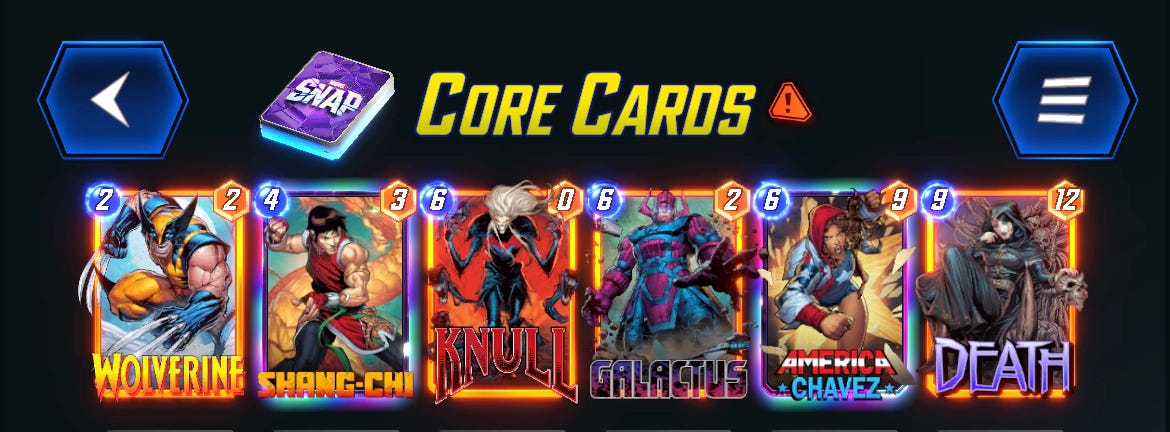
First, the core cards of the deck. I believe that you optimally should be running two out of the three ramp cards currently in the game (more on which to choose later), then include Galactus plus Knull, Death, Shang-Chi and Wolverine. If you have not pulled Knull, I have seen some alternative lists running Gamora, but Knull is almost strictly better in its purpose to win the Galactus lane on turn 6. This deck is much weaker without Knull. As for Death, it is rather convenient to have a free 12 power card to fill the Galactus lane. Shang-Chi may be the best card in the game, and most certainly is in the Galactus lane, as you can win lanes when you don’t have priority with Shang-Chi plus Death. Wolverine is a strong card in this deck, as he is a hidden 4 to 6 power that you can sneak into the Galactus lane.
Some people may say that America Chavez is a core card in Galactus decks, and they may be correct, as you will increase the probability of drawing Galactus by turn 5. I definitely feel that in the “standard” build of the deck she is needed, but I have tried lists that have opted to leave her out and have seen success doing so. More on that later but unless you have a specific purpose behind excluding her, she is a must have card.
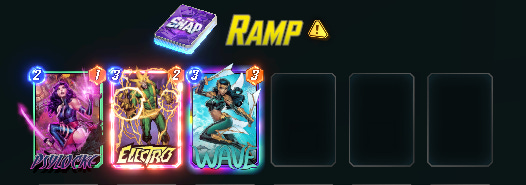
Looking at the ramp cards, each of the three has their own pros & cons.
Wave is the strongest of the three, and honestly I didn’t try running a list without her. She also has the additional benefit of being run in Death-Wave decks, which can help to disguise your play patterns.
I find that Electro is the second best version of ramp ahead of Psylocke with his “downside” being mitigated on turn 6 by Galactus destroying him. He also has the ability to disguise your deck as being a Sandman Ramp deck, which is currently fairly popular in the meta. However, I do believe that he is not an “auto-include”, especially if you are looking to play multiple cards on turns 3 or 4.
Psylocke is the lowest on the ramp totem-pole, but does have her uses. You only need to invest two mana on turn 4 which allows for you to play another card alongside her a to help fill up a location. She is mostly used if you want to be able to play multiple cards in the early game. Psylocke on turn 4 is one of the biggest indicators that you will be Galactus-ing on the next turn, so make sure you have snapped before playing her. If you happen to have both Psylock AND your second form of ramp in your hand, you can bluff playing a Wong deck by playing the Psylocke on turn 2 with the implication being that you will be playing Wong & bait out a potential Cosmo early!
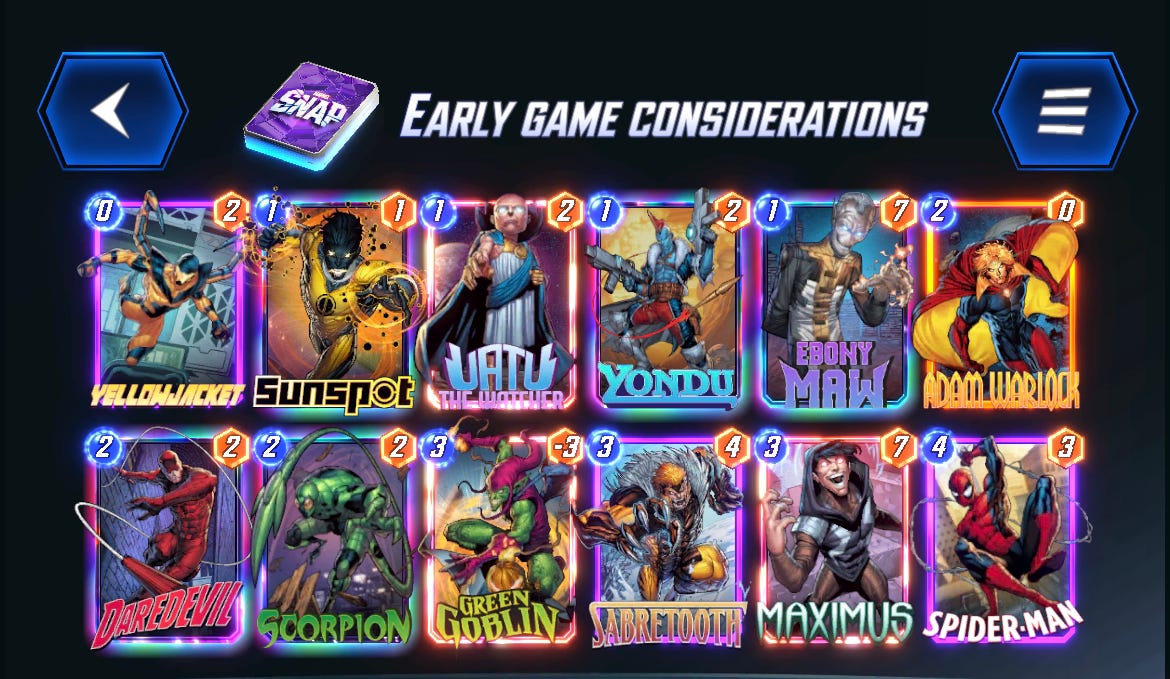
Onto some of the cards that you select for your early game!
Yellow Jacket pairs with Adam Warlock, and the package operates as a “turn 2 draw an extra card” most of the time. This is extremely powerful, as you reduce the odds of not seeing Galactus by turn 5. This is very strong when your game plan is all in on pulling off the win through Galactus.
Sunspot is just one of the best one drops in the game. He works well by allowing you to float mana and continue to increase the size of your Knull. He can be used both as a stand-alone one drop, or as a part of the “Good Card” package from the old Leach Leader style deck if you choose to build your deck this way, using cards like Scorpion, Lizard, Maximus, etc.
Uatu surprisingly has a home in a Galactus deck, as he allows for you to play cards in unrevealed locations to guarantee that you have an open lane to Galactus without dealing with location RNG. However, keep in mind that this is one of the most telegraphing cards in the game when played with most other early game cards (Yondu, Wolverine, etc).
Yondu is almost a must play in this deck, as he synergizes extremely well with Knull & Death. Also builds bluffing potential towards a Death-Wave style deck.
Ebony Maw is an interesting inclusion that I have toyed around with. He has an interesting effect where after you play him, your opponent often dedicates resources to beat his lane in early turns - directing them away from focusing on the potential Galactus lanes. This is one of the cards that I am a little less confident on, and he certainly does have some downsides as he can prevent you from filling up a lane, resulting in more potent Aero pulls, and playing him in the same lane as a Wolverine is a dead giveaway that you are playing Galactus.
Daredevil is a fairly straightforward card… He allows for you to see what your opponent does on turn 5, and prevents a lot of heartache of being hit by Aero or Cosmo. Keep in mind that this is a blatant telegraph that you are playing Galactus, so while you will have more concise wins, you are actually giving up potential cube equity by giving your opponent more knowledge that you are playing Galactus.
Green Goblin & his larger counterpart Hobgoblin are always a consideration when playing a Galactus deck. To be perfectly honest, I haven’t really played too much of Green Goblin, but in theory he has the ability to dictate where your opponent will focus their turn 4 & 5 play. The goblin pair can also can limit the number of spaces that your opponent has in the Galactus lane, and help to guarantee that you win it, but on the other hand it also telegraphs which lane you will be planning on using Galactus.
Sabertooth is a card that I think is a fairly bad, but I have seen him in a few lists. I would need to test him & get surprisingly good results in order to consider him a viable option.
Spiderman is a card that I tried, and he honestly seems like a win-more card. Playing him allows for a play pattern that allows for you to also ramp into Galactus via Wave on turn 4, play Spiderman on turn 5, then hit them with a big card on turn 6. This often seemed like overkill to me, resulting in a similar situation to Zabu Spiderman games of past where your opponent literally cannot do anything so they leave the game. Additionally, I am not a fan of the turn 4 Galactus, as often you and your opponent have not put enough minions on board by this point to reduce Death to 0, and you are giving your opponent an extra turn to play cards like Cosmo into the Galactus Lane.
Decklists
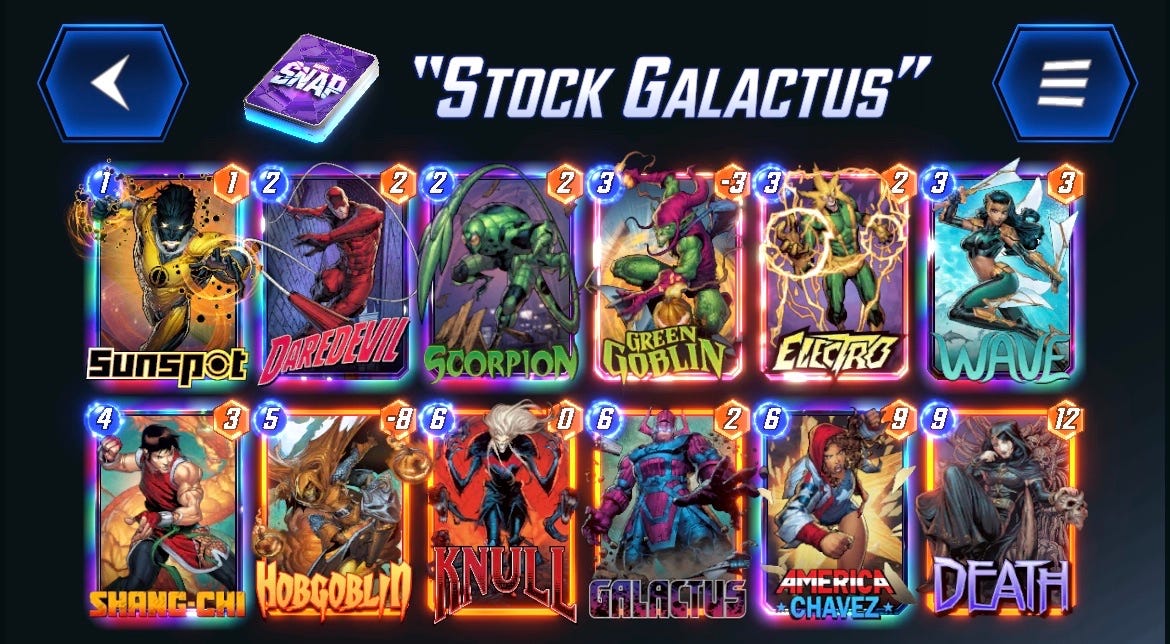
Here are some of the lists that I tried along my Galactus exploration:
This was the first version of Galactus that I played. I ripped it off of Snap.Fan, and it helped me to understand some of the play patterns of the deck. After getting the hang of the deck, I started to customize the list b/c I was not particularly a fan of the Goblins.
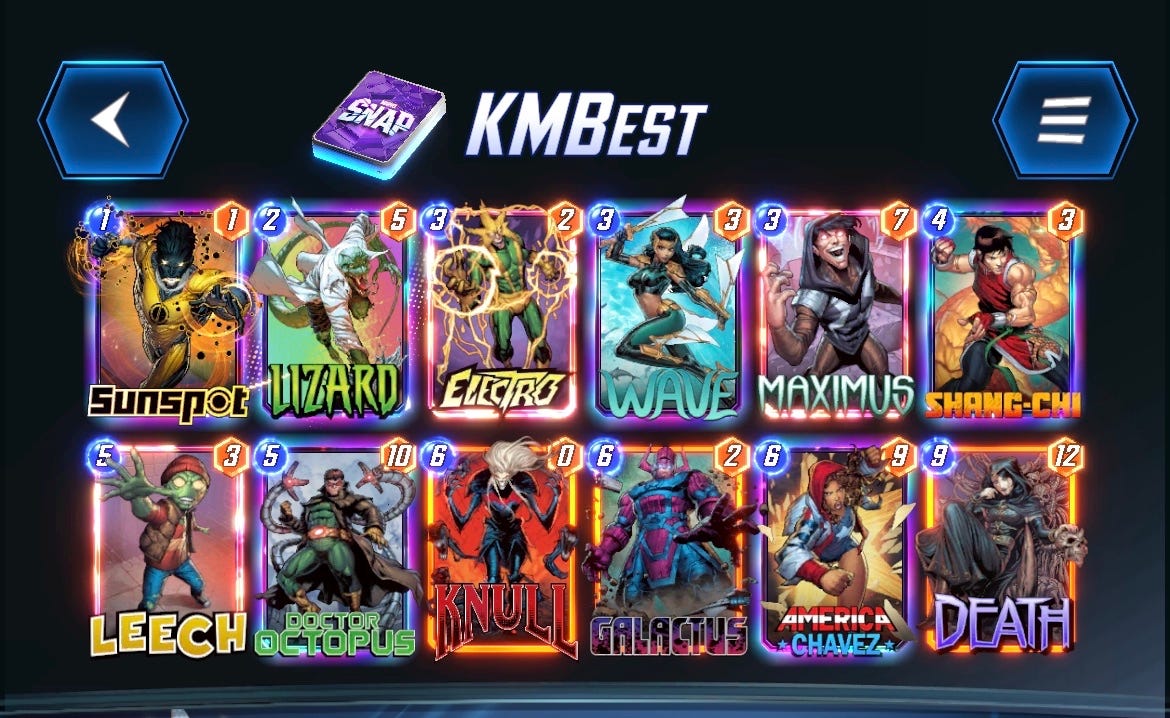
Next, I tried out the KMBest Snapshot list which was built in his traditional style of gameplay, where he cuts out some of the weaker cards and replaces them with “good” cards such as Lizard, Maximus, and Leech. This is the first list that runs Doctor Octopus, a card that I am particularly a fan of, but he is tied to running Electro as your ramp option so that you can play him on turn 4 prior to Galactus and empty your opponent’s hand, giving them less options to play into the Galactus lane.
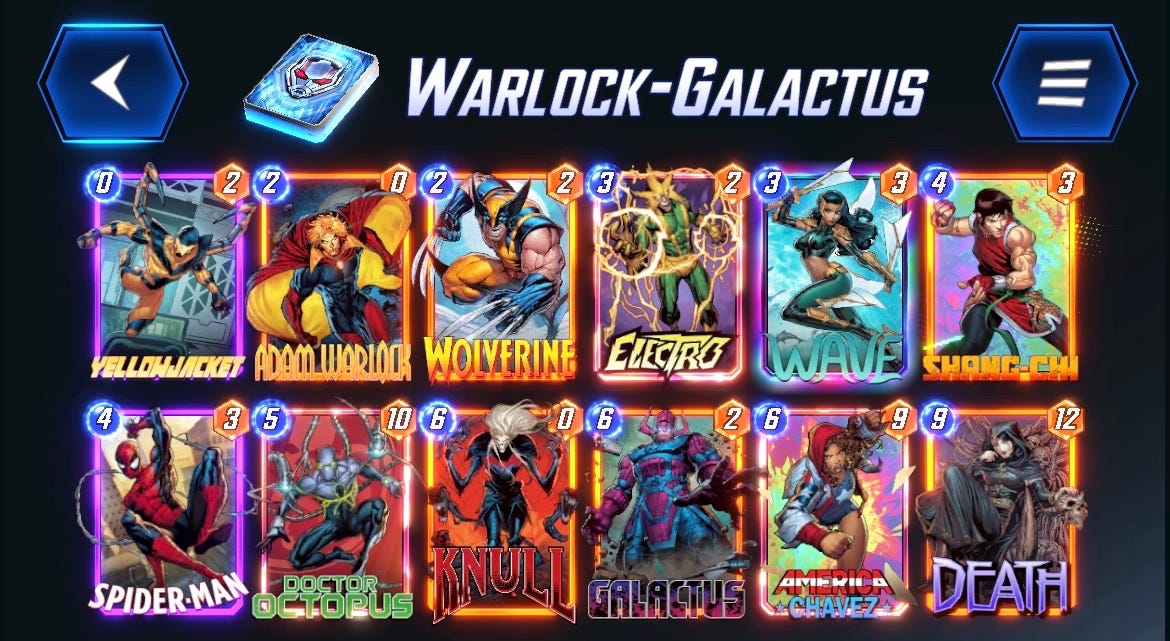
I am a sucker for running Adam Warlock in decks, even though I know statically he is a bad card most of the time. However, I did see some things that I liked with this version of the deck, as the Yellow Jacket / Adam Warlock lane tends to easily fill up to 4 cards, resulting in the devaluation of Aero’s ability against Galactus. I don’t think this is the most refined version of this type of list, Spiderman should be cut for a better card.
This last list really was the catalyst for the next step in my deckbuilding process. The Adam Warlock / Yellow Jacket package helps to increase the consistency of drawing Galactus by turn 5, but in the games where you have unfavorable location RNG or if you happen to not draw Galactus you get blown out, which is a trend that all the lists above seem to have. While the focus of this version of the deck is to minimize the number of times that happens, I started to ponder down that train of thought…
Hybridization of Galactus - My Innovation
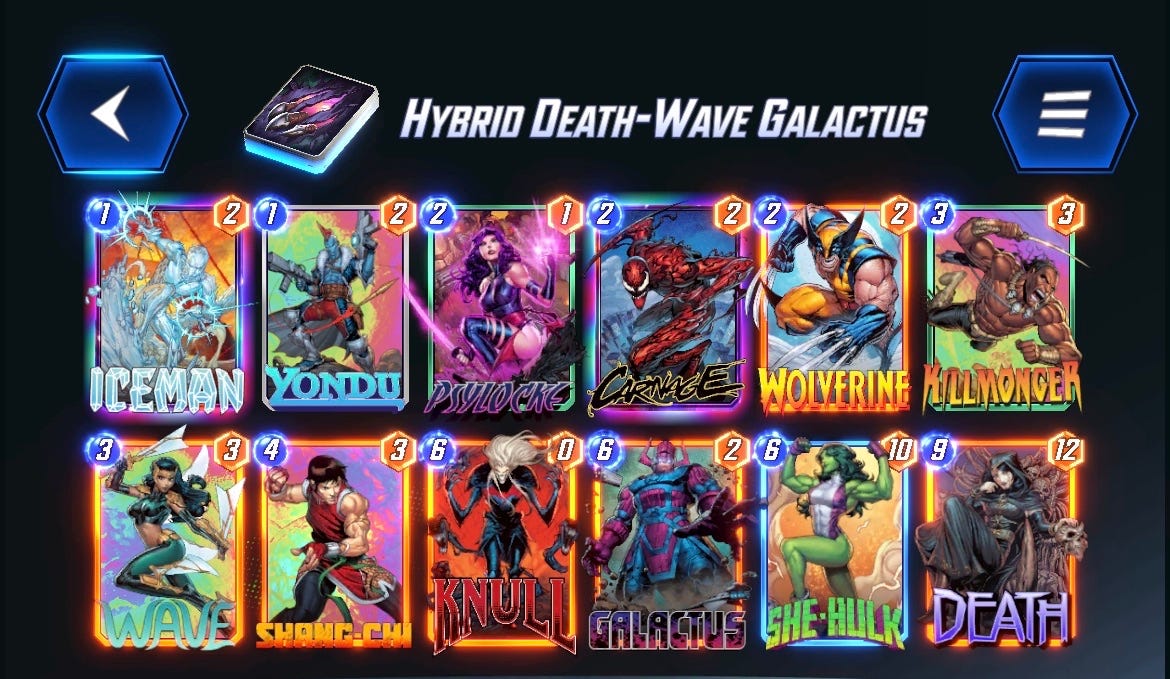
After playing two matches in a row that had Central Park as a location, followed by a game where I didn’t draw Galactus, I started to think more about games where you DIDN’T hit the Galactus win condition. How could you improve your deck so that you had a chance of winning the games where you either got bad location RNG, or didn’t draw the big baddy? The answer came to me after thinking about how I often was “bluffing” that my Galactus deck was a Death-Wave style deck and thought, what happens if I start including more Death-Wave style cards and have the flexibility to win with an alternate win condition of the traditional turn five Wave followed by Knull + She-Hulk + Death?
This deck has been insanely strong when I have piloted it, as now the Galactus is much more of a surprise factor, as the only “tells” that you are playing Galactus is Psylocke or an early Wave on turn 4. They often think that you are a Death-Wave deck, and you actively get more snaps to resolve prior to the Galactus turn. Additionally, you can salvage bad draws and location RNG with via turn 5 Wave and traditional Death-Wave Gameplay.
The deck is currently only about a day old, but it feels super strong as of now. I am continually looking to iterate on its play, and may have some changes after I play it a bit more.
Summary
Overall, Galactus was a lot more nuanced of a deck than I gave it credit for before starting to play it, and having the card for only a few days has allowed for me to recognize that there is still a good amount of deck discovery space surrounding the card. This quick dive into Galactus Gameplay has really allowed for me to realize that there is a ton of depth within Marvel Snap, and there is a ton of room for myself to improve as a player.